

Most homeowners assume a luxury bathroom requires a luxury budget. It does not.
Luxury is rarely about spending more. It is about spending in the right places. When the budget is concentrated in a small number of high-visibility elements, the entire room lifts. When it is spread evenly across everything, nothing stands out. The difference comes down to focus.
This guide explains where to spend first, where to spend second, and where to make sensible compromises.
Spend First: The Anchor
Every successful bathroom has one element that carries the room. Everything else supports it. In most coastal NSW homes, that element is a freestanding bath or a rainfall shower. The choice depends on the space and how it is used. What matters is the principle: pick one feature, put a meaningful share of the budget into it, and build around it.
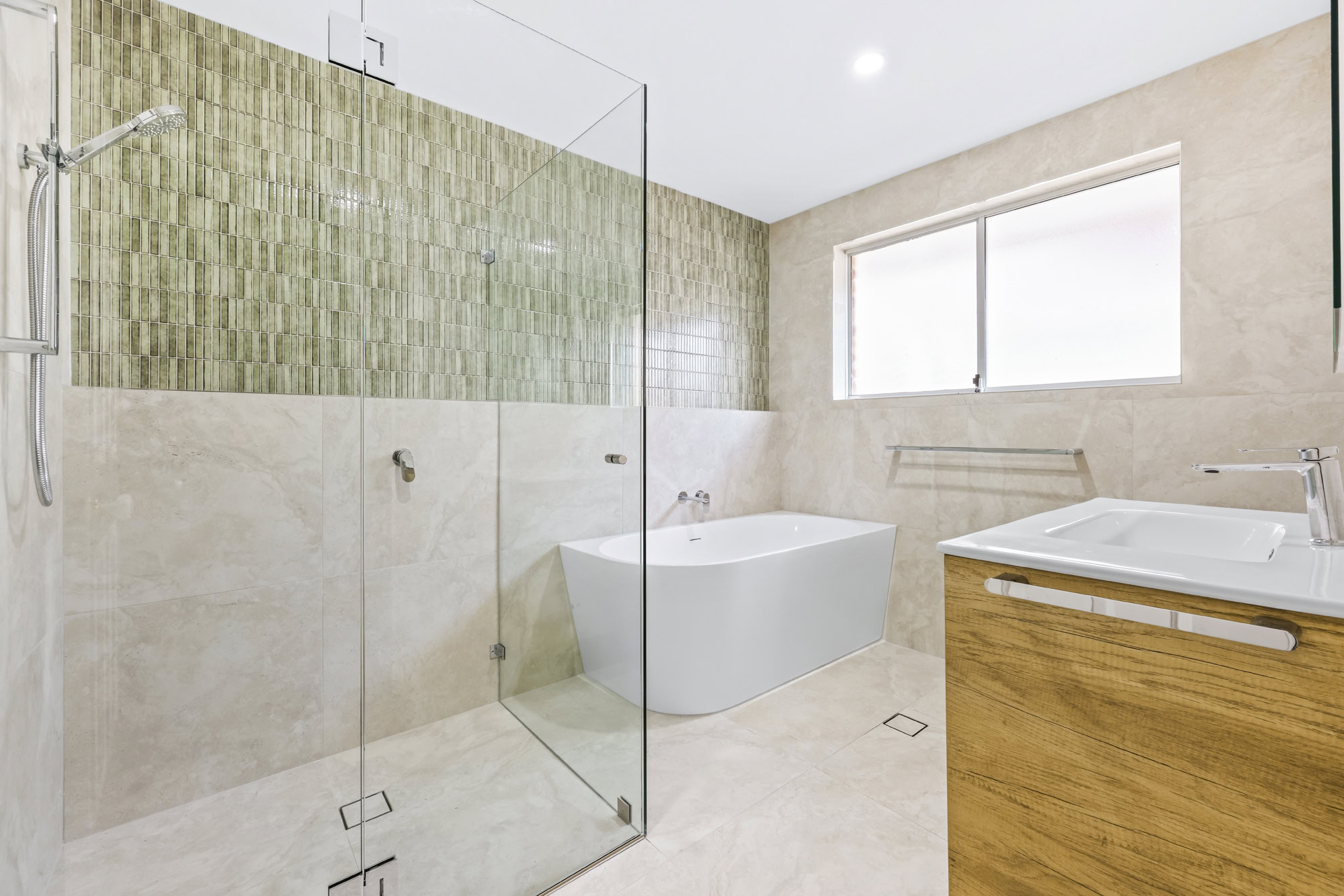
A freestanding bath is the clearest signal that a room was designed, not installed. It draws the eye and holds attention, which means the tiles, cabinetry, and walls behind it can be more modest without the room feeling that way. In the relaxed aesthetic that suits homes from the Northern Beaches through to Port Macquarie, a clean oval acrylic bath in matte white or a warm stone tone fits naturally. Oval acrylic options start from around $800 to $1,500 as a general guide — prices vary by supplier and specification.
Where a freestanding bath is not practical, a ceiling-mounted rainfall shower head does the same work. Quality hardware runs from around $150 to $400. Where cost accumulates is in the plumbing if the existing layout does not support an overhead supply. If walls are already opening for other reasons, add the rough-in at that point. Retrofitting later costs considerably more.
Either choice pairs best with frameless glass. Fully frameless 10mm glass is within reach on most mid-range budgets; semi-frameless, where the panels are fixed, but the door has a minimal frame, reads nearly as clean at a lower price. Heavy chrome-framed enclosures date a bathroom faster than almost anything else.

Spend Second: The Visual System
Once the anchor is set, a handful of secondary decisions determine whether the rest of the room reinforces it or undermines it.
Tapware has an outsized effect relative to its cost. Wall-mounted mixers in matte black or brushed nickel visually anchor the basin or bath without competing with it. Builder-grade chrome does the opposite — it is one of the most consistent ways to make a room feel cheaper than it is. Swapping just the tapware, nothing else, is a change that registers immediately.
Large-format tiles (600x600mm and above) reduce grout lines, remove visual noise, and let the eye move across floors and walls without interruption. Rectified porcelain in concrete, linen, or stone-look finishes achieves a premium surface without the price or upkeep of natural stone, which requires regular sealing and stains in wet areas without careful maintenance.
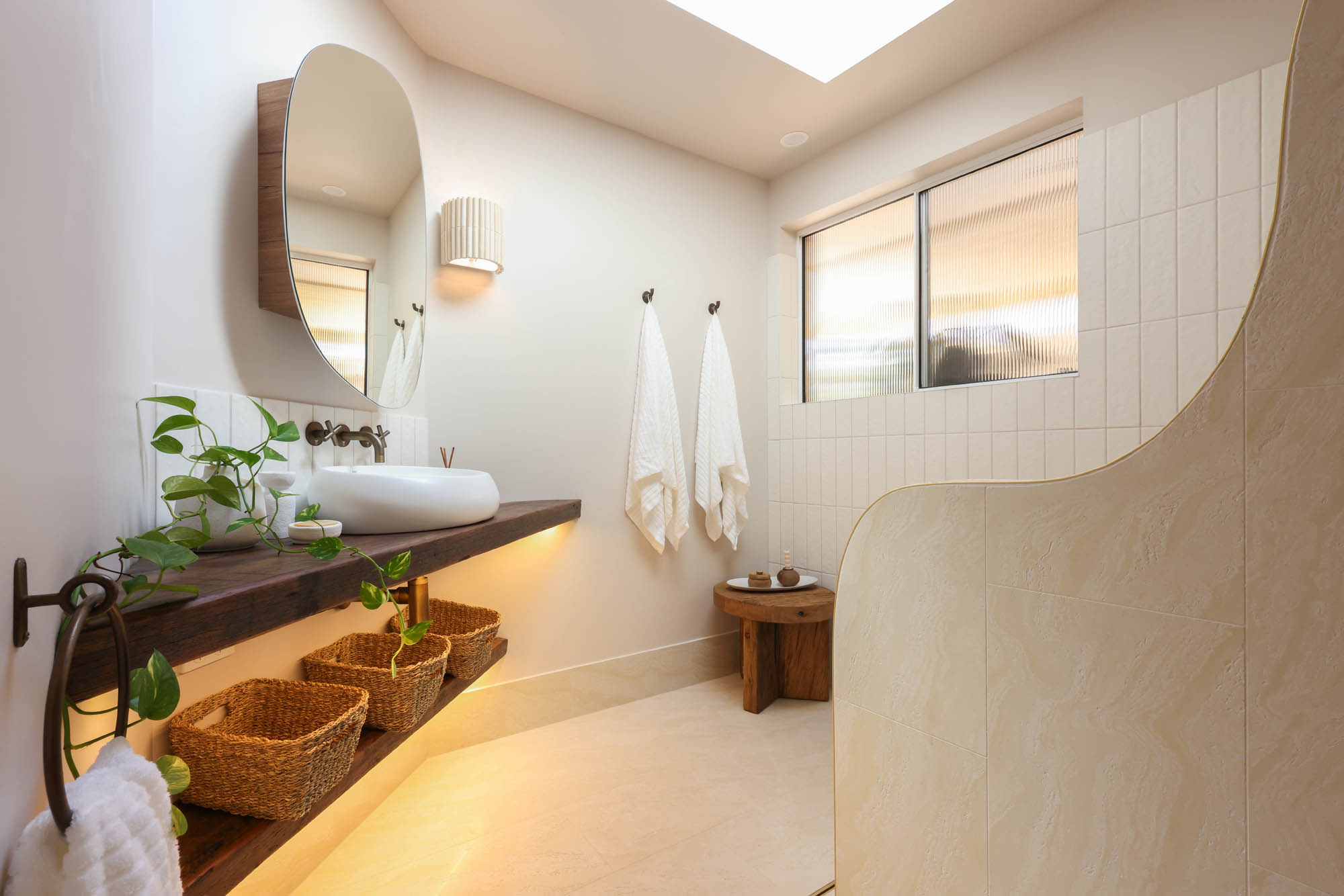
Lighting is consistently the most undercooked element in renovation budgets, and the one with the most leverage. Vanity lighting mounted on either side of the mirror eliminates the shadows that a single overhead downlight creates and makes the space feel considered rather than functional. A dimmable circuit adds range without high cost. A full-width LED mirror with integrated demisting, sized to span the vanity, defines the wall rather than decorating it.
Cabinetry rounds out the visual system. The finish matters more than the substrate. A flat-panel door in a quality matte finish — navy, charcoal, warm white, deep sage — reads as a design choice rather than a default. Timber-look vinyl wraps have improved significantly and hold up well in bathroom conditions. If existing cabinet boxes are sound, refinishing or re-dooring them is often one of the highest-impact, lowest-cost upgrades in the entire renovation.
Spend Third: The Comfort Layer
These are the upgrades that do not define how a bathroom looks, but determine how much you enjoy living in it. They are also consistently what buyers remember.
Underfloor heating is the clearest example. An electric mat system, installed during a tile replacement, typically adds $300 to $600 to the project. Running costs are minimal. In Taree, Port Macquarie, and up toward Coffs Harbour, July mornings are cold enough that this matters. If the full floor is over budget, heat just the zone in front of the vanity and shower.
A heated towel rail ($250 to $500 installed) delivers warm, dry towels every morning. It is a small thing that makes a bathroom feel cared for rather than merely renovated.
Finally, accessories. Towel rails, robe hooks, and toilet roll holders are usually chosen last and quickly. Mismatched finishes are one of the most reliable ways to undercut otherwise strong work. Choose one finish: brushed nickel, matte black, or gunmetal, and order everything at once.
All figures above are indicative only and based on general market pricing at the time of writing. Actual costs depend on product selection, supplier, and site conditions. Contact Blue Sky for an accurate quote.
What Not to Cut
Once the design decisions are made, execution is where most projects succeed or fail.
Plumbing, waterproofing, and electrical work in NSW all require licensed tradespeople. Waterproofing failures are the leading cause of bathrooms needing full demolition and rebuild, typically surfacing three to five years after the original job. A bathroom can look perfect on the surface while carrying serious water ingress behind the tiles, with no sign until the damage is extensive. Getting it right the first time costs far less than fixing it later. For a detailed look at where renovations go wrong, see our guide to common bathroom renovation mistakes.
Bathroom electrical circuits require residual current devices and specific cable ratings for wet areas. The risks go beyond a failed council inspection.
Once these fundamentals are in place, the quality of execution becomes the deciding factor.
Blue Sky manages the complete trade sequence across the Mid-North Coast and Northern Beaches: waterproofing, plumbing, tiling, and electrical work coordinated as a single project. The features you have chosen go in properly and stay that way.

The Mindset That Makes It Work
The bathrooms that feel most luxurious are rarely the ones with the highest budgets. They are the ones where clear decisions were made, the budget followed those decisions, and the execution was done properly.
Anchor first. The visual system second. Comfort layer third. Fundamentals non-negotiable.
That sequence is how a modest renovation produces a result that surprises people. If you want help working through what it looks like for your specific space and budget, contact Blue Sky Home Renovations for an obligation-free consultation.
Frequently Asked Questions
What luxury bathroom features add the most value to a home?
Freestanding baths, rainfall showers, and frameless glass screens consistently attract buyer attention. Underfloor heating and quality tapware also score well in pre-sale inspections. For more on this, see our article on enhancing your home’s value with a bathroom renovation.
Can you create a luxury bathroom on a modest budget?
Yes, if the money is concentrated. One strong anchor surrounded by clean, well-installed basics reads as considered. A bathroom where the budget was spread thinly across many small upgrades rarely does. Choose the anchor first, then build around it.
What is the most affordable way to make a bathroom look more high-end?
Replace the tapware and accessories in a consistent finish. Add a large mirror. Improve the lighting. Re-grout or reseal discoloured grout. None of these requires a full renovation, and all register immediately.
Is underfloor heating worth the investment in Australian homes?
In coastal NSW, yes. It costs less to install than most people expect, running costs are minimal, and the comfort improvement is real even in a mild climate. It is consistently one of the features buyers mention after inspections.
What are some affordable alternatives to natural stone in bathrooms?
Large-format porcelain in stone-look finishes. The visual difference in daily use is minor, but the practical difference is significant: harder, less porous, no sealing required, and considerably cheaper. Engineered stone benchtops offer the same trade-off for vanity surfaces.
How can lighting make a bathroom feel more luxurious?
More than most people realise. A tile that looks flat under a single overhead downlight looks rich under layered lighting with a warm colour temperature. Dedicated vanity lighting removes shadows and changes how the space feels to use day-to-day. A dimmable circuit creates two modes: bright and practical in the morning, warm and calm at night. A full-width LED mirror makes a stronger statement than a standard mirror with a separate fitting above it. These are not expensive decisions — they are decisions most people make too late, or not at all.
What bathroom upgrades offer the best balance of style and practicality?
Wall-hung vanities, large-format tiles, heated towel rails, rainfall showers, and recessed shower niches. The niche in particular is worth building in: it removes the caddy, looks clean, and is one of those features people find difficult to give up once they have lived with it.
How do I avoid overspending during a bathroom renovation?
Set a budget by category before choosing any products: tiles, fixtures, labour, and a contingency of 10 to 15 per cent. Most blowouts come from scope creep — decisions changed mid-project or surprises uncovered during demolition. A fixed or itemised quote from a licensed builder locks in the scope before work begins. For a realistic picture of timelines and what drives them, see our guide on how long a bathroom renovation takes in NSW.